
Israel and the United States have launched coordinated strikes on Iran’s entire transportation network — railways, bridges, freeways, and major highways across the country. The IDF issued a warning to Iranian citizens to refrain from all train travel for 12 hours. The scale of the targeting suggests the objective is not military degradation but the severing of civilian mobility across the entire nation.
UPDATE: The US has also struck military targets on Kharg Island overnight, according to White House and US officials. The strikes reportedly did not target oil facilities. This is the second US strike on Kharg Island — the first hit 90 targets on March 13 including naval mine storage, missile bunkers, and military sites. Kharg Island handles the majority of Iran’s oil exports.
The strikes are confirmed across multiple provinces and cities:
Railways: Multiple railway lines struck. Two killed in an attack on a railway bridge in the city of Kashan, according to the semi-official Mehr News Agency. The Iranian Red Crescent Society reported an airstrike on a railway line in Karaj, with video showing workers treating the injured at the scene.
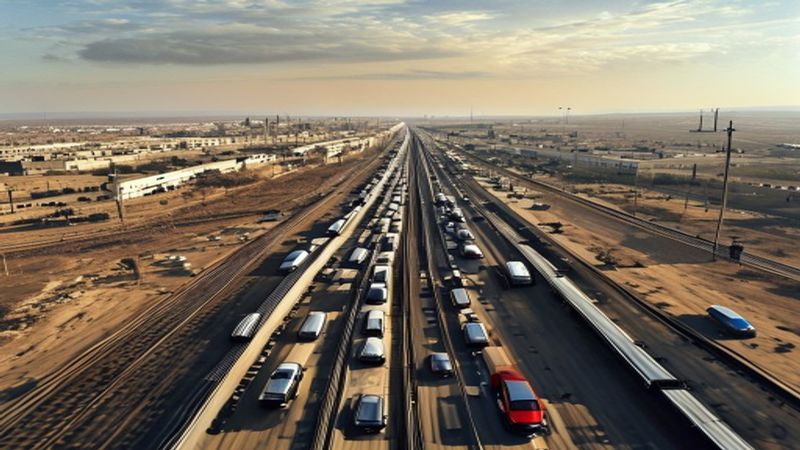
Highways and Freeways: A section of the Tabriz-Tehran freeway was struck. Another freeway between Tabriz and Zanjan has been closed. The Qareh Chaman-Mianeh road closed in both directions due to projectile impacts. A road in the city of Ahvaz was struck.
Bridges: Ground transport bridges in western Qom Province were targeted. This follows the destruction of Iran’s largest bridge earlier in the campaign.
Civilian Areas: Iranian state media reports that residential and commercial areas have also been hit in the attacks.
An Israeli source told CNN that the strikes are targeting “all transportation routes — railways, bridges, and major highways” because Israel sees Iran using these routes to mobilize trucks carrying ammunition, missiles, and missile launchers.
Related: NewsRescue — A Whole Civilization Will Die Tonight: Trump Issues What Reads as Nuclear Ultimatum
The military justification — that roads carry weapons — applies to every road in every country during every war. Armies move on roads. Civilians also move on roads. Food moves on roads. Medicine moves on roads. When you destroy a nation’s entire transportation network, you do not simply prevent military logistics. You prevent a society from functioning.
The IDF’s warning to civilians to avoid trains for 12 hours acknowledges that civilians use these systems. The strikes that followed — on railways where workers were treating injured passengers — demonstrate the gap between warning and reality. A warning issued hours before bombs fall on infrastructure that takes years to rebuild is not protection. It is documentation of foreknowledge.
Iran is a country of 88 million people spread across 1.6 million square kilometers. Its railway network connects cities separated by vast distances across mountain ranges and desert. Its highway system is the only means by which food, fuel, and medical supplies reach much of the population. Severing these connections does not degrade military capability in isolation. It degrades the ability of a civilization to sustain itself.
Related: NewsRescue — Trump Escalates, Iran Says Delusional Threats Will Not Hide Humiliation
This is happening on the same day President Trump posted on Truth Social that “a whole civilization will die tonight, never to be brought back again.” The systematic destruction of transportation infrastructure across an entire country — railways, highways, bridges, freeways, in province after province — is what that statement looks like when translated from rhetoric into military action.
Under international humanitarian law, attacks on infrastructure essential to civilian survival are prohibited under the principle of proportionality and the prohibition on collective punishment. The Fourth Geneva Convention specifically protects civilian objects. A railway bridge where two people died in Kashan was not a military installation. A freeway between Tabriz and Zanjan is not a weapons depot. A road in Ahvaz is not a missile launcher.
The generals who might have advised against targeting an entire nation’s civilian transportation network have been fired. The institutional voices that might have raised legal objections within the chain of command have been removed. What remains is a campaign operating without the internal checks that the US military was designed to have — checks that exist precisely to prevent the kind of systematic civilian infrastructure destruction now being documented in real time across Iran.
Two people died on a railway bridge in Kashan today. Their names will not make international headlines. The railway they were traveling on when it was struck will take years to rebuild — if it is rebuilt at all. The civilization that built it has existed for thousands of years. Tonight, according to the President of the United States, it will probably die.