
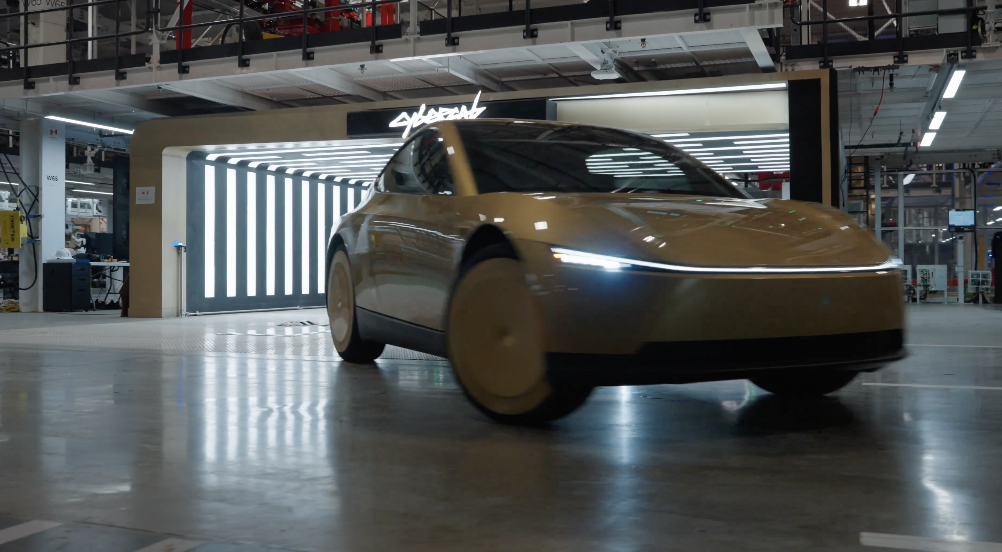

Elon Musk has confirmed that the Tesla Cybercab – the company’s purpose-built, steering-wheel-free, two-seat robotaxi – has officially entered production. The announcement, made on X, marks the moment a concept Musk has been promising for the better part of a decade finally moves from prototype clay to assembly line.
A Vehicle That Looks Like the Future
Whatever one’s politics on Musk, the design is hard to argue with. The Cybercab carries the same restrained, almost monolithic aesthetic that has come to define Tesla’s industrial language – flush surfaces, no door handles, butterfly doors, a single screen, and a silhouette that looks more like a piece of consumer electronics than a car. It is the rare vehicle that does not look dated the moment it leaves the studio. In a category usually defined by minivans wearing sensor hats, the Cybercab arrives as something visually coherent. The future, finally, looks like the future.
Waymo’s Atlanta Hiccup – A Reminder That This Is Hard
Tesla’s announcement lands at an awkward moment for the broader robotaxi space. In Atlanta, where Waymo has been expanding aggressively, three of the company’s autonomous vehicles recently brought traffic to a standstill at a single intersection after apparently failing to interpret a flashing red traffic signal correctly. A flashing red, in US traffic code, functions as a stop sign – proceed when clear. The Waymos, by available accounts, did not proceed. Other drivers had to navigate around them.
The episode is not an indictment of autonomy – it is a reminder that the long tail of edge cases is exactly where this technology lives or dies. A car that handles 99 percent of intersections is still a car that strands its passengers at the hundredth. Waymo’s track record over hundreds of millions of driverless miles remains, on balance, impressive. But Atlanta shows that the gap between “very good” and “production-ready at scale” is real, and Tesla, a relative latecomer to revenue-generating robotaxi service, is walking into the same minefield Waymo has been mapping for years.
The Job Market Wave Is About to Land
Beyond the engineering, there is a labour question the political class has spent years pretending it does not see. Uber and Lyft together employ several million drivers in the United States alone. The arrival of a purpose-built, low-cost robotaxi – Musk has previously suggested a sub-$30,000 price point and rides at a fraction of current ride-hail fares – does not threaten those drivers in the abstract. It threatens them on a timeline.
For many of those drivers, the gig was already a stopgap – a layer of income smoothing the edges of an economy that has not produced enough good jobs in two decades. As Cybercabs and Waymos and whatever Amazon eventually rolls out begin to take meaningful market share, that stopgap closes. Where do those drivers go? Is the labour market – already absorbing displaced retail, customer service, and now early-career white-collar workers as AI matures – ready for another wave?
The Reality
None of this is a reason to slow the technology. Autonomy will save lives – the leading cause of death for Americans under 45 is, still, the human behind the wheel. Cleaner, cheaper, safer mobility is a public good. But the transition is going to compress a generation of labour disruption into a handful of years, and the conversation about how to absorb it is barely beginning.
The Cybercab rolling off the line is, on its own terms, a milestone worth marking – the moment a piece of science fiction becomes inventory. The Atlanta intersection and the unemployment office are the rest of the story.