
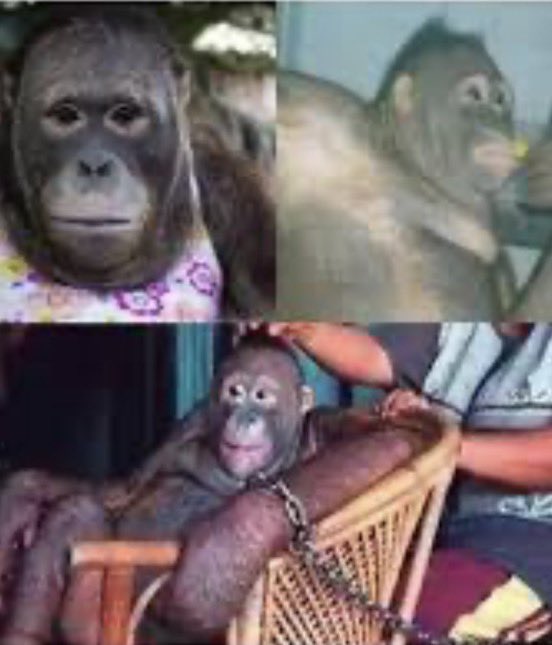

In a village called Kareng Pangi in Central Kalimantan, on the Indonesian side of Borneo, there existed for six years a crime so grotesque that its rescue required 35 armed police officers with AK-47s. The victim was not a human being. Her name was Pony, and she was a Bornean orangutan — a critically endangered species — who had been forced into prostitution.
Born around 1996, Pony was stolen from her mother as a baby. She ended up in a brothel, chained to a filthy mattress, where local palm oil workers paid roughly 35,000 Indonesian rupiah — about two British pounds — to rape her.
The Horror in Detail
Every two days, Pony’s captors shaved off all her body hair to expose her skin, leaving her defenseless against the swarms of mosquitoes that covered her in infected bites. They dressed her in lipstick, perfume, and jewelry. They trained her to sway her hips when men walked past her room — a conditioned reflex born from years of abuse.
She was the brothel’s most profitable asset. While human sex workers operated in the same establishment, men chose Pony more often — drawn to what they considered the “novelty” of an orangutan. She was forced to serve multiple customers every day without rest, chained in place so she could not escape.
The brothel’s madam treated her not as a living being but as a machine — one that generated more revenue than any human worker under her control.
The Rescue That Required an Army
In February 2003, the Borneo Orangutan Survival Foundation (BOSF) learned of Pony’s existence and launched a rescue operation. What they encountered was not a simple extraction. The villagers who profited from Pony’s exploitation — and the brothel owner who considered her a “talisman” and primary income source — fiercely resisted.
BOSF had to call in local police. In the end, it took a squad of 35 officers armed with AK-47 rifles to force the village to surrender a single orangutan. The scale of that operation tells you everything about how valuable her suffering was to the people around her.
On February 13, 2003, Pony was brought to BOSF’s Nyaru Menteng rehabilitation center. She arrived in devastating condition — hairless, covered in mosquito bites and infected wounds, psychologically shattered.
Recovery, But Not Release
BOSF’s veterinary team provided immediate intensive care. Over time, Pony was placed in the center’s Forest School, where caretakers — called “babysitters” — tried to teach her the survival skills that six years of captivity had denied her. She slowly began to socialize with other orangutans.
But the trauma runs too deep. To this day, Pony cannot be released into the wild. The psychological damage and her lack of natural survival skills — things her mother would have taught her had she not been stolen as an infant — make independent life in the forest impossible. She lives in a protected, naturalistic enclosure at BOSF, receiving specialized veterinary care and behavioral enrichment. She has shown significant progress, but she will never be free in the way nature intended.
What This Story Reveals
Pony’s case is not ancient history. It happened in the 21st century, in a country with wildlife protection laws on the books, in a region where the palm oil industry has already decimated orangutan habitats to the point of species crisis. The Bornean orangutan population has declined by more than 50 percent in the past 60 years. Fewer than 104,000 remain.
The men who paid two pounds to assault an endangered animal were not prosecuted. The brothel owner who chained her to a mattress for six years was not, by available accounts, imprisoned. The village that required an armed military-style operation to surrender one orangutan faced no collective consequence.
Is it not worth asking why a story this extreme — an endangered species forced into sexual slavery for half a decade in a brothel that also employed human women — received so little sustained international attention? Why the palm oil workers who created the demand, the madam who supplied it, and the system that enabled it were never held to account?
Pony survived. She is alive today, more than two decades later, in the care of people who treat her as what she always was — a sentient being who deserved none of what was done to her. But survival is not justice. And the conditions that made her exploitation possible — poverty, lawlessness, the destruction of orangutan habitat by the same industry whose workers were her abusers — have not changed.
Her story is not just about one orangutan in one village. It is about what human beings are capable of when no one is watching, and what systems of power allow when accountability does not exist.