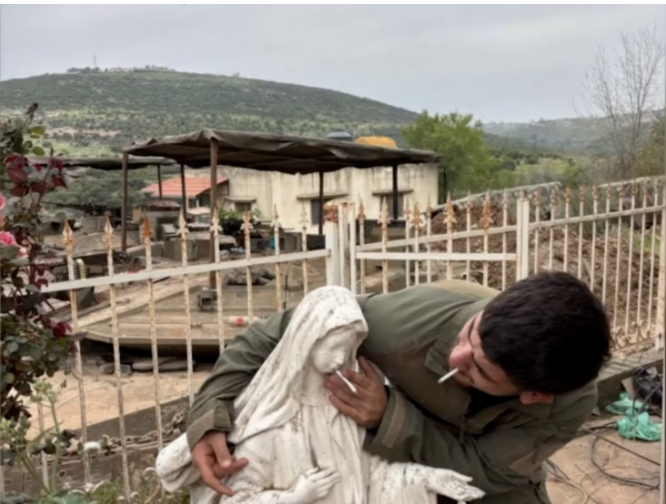

A photograph showing an Israeli soldier placing a cigarette in the mouth of a Virgin Mary statue in southern Lebanon has triggered widespread outrage online. The image surfaced this week and was reportedly taken in Dibil, a predominantly Christian village near the Israeli border — and shared on social media by IDF soldiers themselves.
The Israeli military responded with a statement saying it views the incident “with utmost severity” and that the soldier’s conduct “completely deviates” from its values. The IDF said the photo had been taken several weeks earlier, that a formal investigation was underway, and that “command measures” would follow. It stressed respect for holy sites and religious symbols.
A pattern, not an incident
The cigarette photo is the latest in a documented pattern of Israeli forces’ behaviour toward Lebanon’s Christian community. In April 2026, video circulated of an IDF soldier destroying a statue of Jesus Christ in the same village of Dibil — using a large mallet, during ground operations in southern Lebanon. The damaged crucifix was later photographed and posted to the town’s official page alongside a biblical inscription:
“Father, forgive them; for they know not what they do.”
The IDF confirmed that two soldiers involved in that vandalism were withdrawn from combat and imprisoned for 30 days after the video went viral.
Christians on the receiving end of “Israeli values”
Christian communities across the region have catalogued repeated incidents involving Israeli forces and Christian sites:
- 2023: Israeli airstrike near Gaza’s Greek Orthodox Church of Saint Porphyrius killed at least 18 people sheltering inside.
- 2025: Tank-shell shrapnel struck Gaza’s Holy Family Church, killing three.
- March 2026: A Catholic nun was assaulted in Jerusalem.
- April 2026: Jesus statue smashed with a mallet in Dibil, southern Lebanon.
- May 2026: Cigarette placed in Virgin Mary’s mouth — same village.
Israel launched its current combat operation in Lebanon on March 2, 2026. The pattern of religious-site incidents has accelerated since.
For Lebanon’s Christians — who once trusted that an Israeli military “rooted in Judeo-Christian values” would handle their churches with care — the cigarette photograph is a reminder of how that promise reads on the ground.