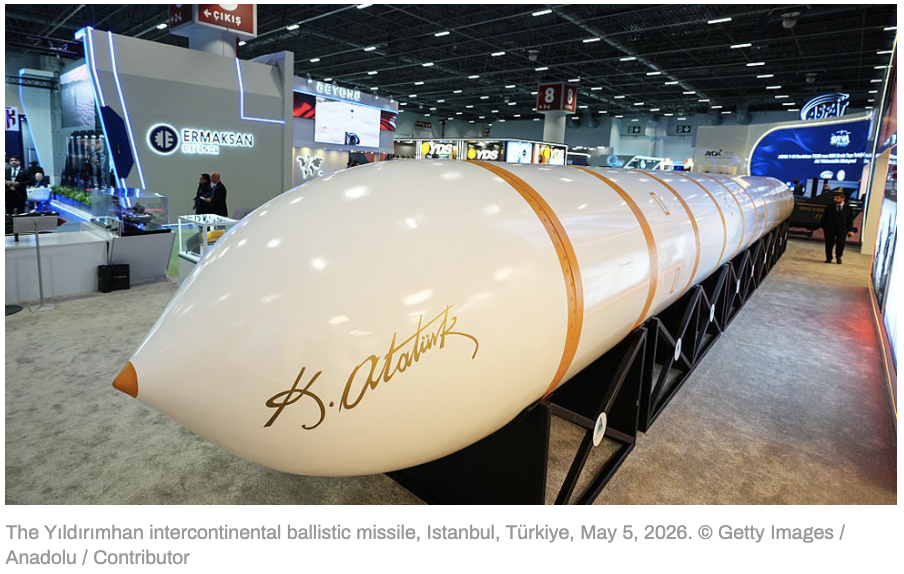

Türkiye has unveiled its first intercontinental ballistic missile, the Yildirimhan, which officials say will significantly extend the country’s long-range strike capability and serve primarily as a deterrent — but one Ankara has signaled it is willing to use.
The missile was presented at the SAHA 2026 defense industry expo in Istanbul on Tuesday. Developed by state defense contractor ROKETSAN, the Yildirimhan has an estimated range of around 6,000 km (3,720 miles), putting most of Europe, North Africa, and large parts of Asia within reach.
Defense Minister Yasar Guler described the system as the country’s longest-range missile to date and its first liquid-fuel design capable of hypersonic flight. Speaking at the unveiling, he said the ICBM represents a “major step” in Türkiye’s defense capabilities.
“If we have to use it, no one should doubt that we will do so without hesitation, and in the most effective way.”
— Defense Minister Yasar Guler
Specifications
- Range: 6,000 km (3,720 miles)
- Speed: Mach 9–25 (hypersonic)
- Fuel: Liquid Nitrogen Tetroxide (N₂O₄)
- Propulsion: 4 rocket thrust motors
- Developer: ROKETSAN
A rapidly expanding defense industry
Guler said the national defense industry has sharply increased production capacity, and that Turkish military systems have proven themselves in conflict zones across Syria, Iraq, Libya, and the South Caucasus. He claimed locally built platforms — developed to NATO standards at lower cost — are directly affecting the military capabilities of foreign armies, and that Türkiye has transitioned from an import-dependent buyer to a nation that “designs, produces and exports its own systems.”
In recent years Ankara has fielded combat drones, cruise missiles, and ground-based systems, with Bayraktar TB2 strikes shaping conflicts from eastern Europe to North Africa.
Timing: post-Iran war
The unveiling lands during heightened Middle Eastern tensions following the US-Israeli war on Iran that began in late February. Foreign Minister Hakan Fidan reportedly acknowledged that the Iran conflict gave Ankara an added incentive to accelerate domestic weapons and air-defense production — a reading that places the Yildirimhan as much in dialogue with Tel Aviv and Washington as with Tehran or Damascus.