
U.S. President Donald Trump announced overnight that American special forces, working alongside the Armed Forces of Nigeria, had eliminated Abu-Bilal al-Minuki — whom he described as the “second in command of ISIS globally.” Nigerian President Bola Tinubu echoed the claim, hailing it as a milestone in the joint counter-terror partnership.
There is one problem with the celebration. The Nigerian Defence Headquarters (DHQ) already announced that it killed Abu Bilal Minuki — listed by that exact name — in April 2024, citing operations conducted between January and March of that year in the Birnin Gwari forest area of Kaduna State.
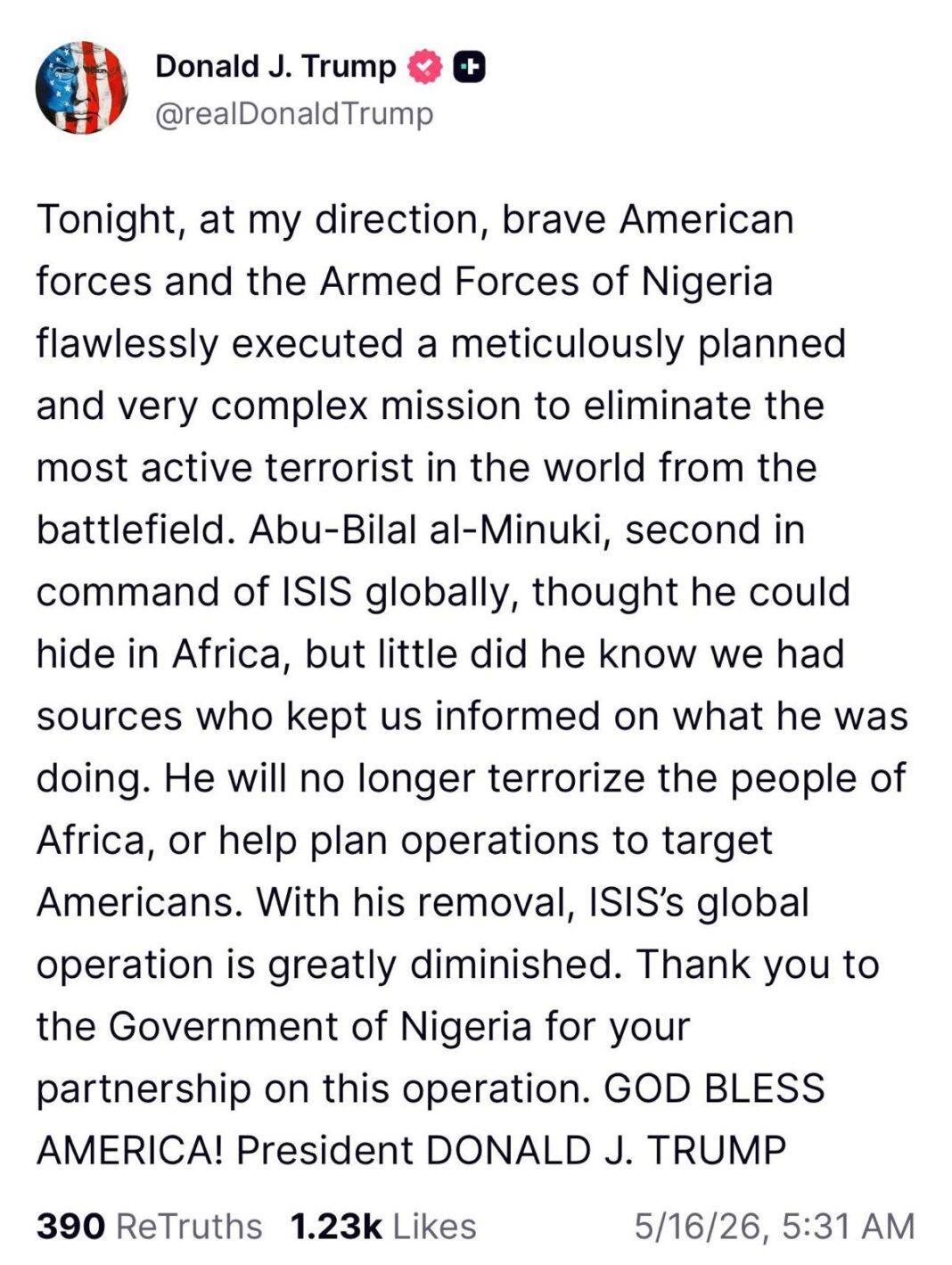
“Tonight, at my direction, brave American forces and the Armed Forces of Nigeria flawlessly executed a meticulously planned and very complex mission to eliminate the most active terrorist in the world from the battlefield. Abu-Bilal al-Minuki, second in command of ISIS globally, thought he could hide in Africa…”
— Donald Trump, Truth Social, 5:31 AM, 5/16/26
Killed twice, two years apart
The earlier 2024 announcement was not vague. The DHQ named Abu Bilal Minuki in its formal quarterly briefing as one of the top terrorist commanders neutralised during the Birnin Gwari operations. The Nigerian press carried the story at the time. The name and the role were the same.
Two years later, an apparently identical figure is being killed again — this time by a U.S.-Nigerian joint operation, and this time announced from the Oval Office.
The official explanation: it’s a different guy with the same name
Pressed for clarification, DHQ’s Director of Defence Information, Somalia Uba, said the 2024 killing and the 2026 killing involved two different men who happened to share the name “Abu Bilal Minuki.”
“The use of similar or identical names, aliases and nom-de-guerres is prevalent among ISWAP and Boko Haram terrorists” as “a deliberate part of their indoctrination strategy.”
— Somalia Uba, DHQ
According to the DHQ, the May 16, 2026 target was “positively identified through human intelligence and technical surveillance as a senior global operative” with “direct connections to international terrorist coordination.”
The Defence Headquarters offered no biometric, photographic, or DNA comparison between the man Nigeria said it killed in 2024 and the man Trump and Tinubu announced was killed in 2026. The explanation rests entirely on the claim that two senior commanders of the same group, in the same theatre, in the same role, happened to be operating under the same name within two years of each other.
Falana: not buying it
Prominent Nigerian human rights lawyer Femi Falana, SAN, publicly faulted both presidents over the announcement, calling on Tinubu to verify Trump’s claim before endorsing it. Falana flagged the contradiction with the 2024 DHQ statement directly and questioned whether the Nigerian government had checked its own kill list before agreeing to share the announcement with Washington.
The pattern
Top Boko Haram and ISWAP leaders being declared dead, then resurfacing — or being declared dead a second time — is not new. Abubakar Shekau, the late Boko Haram leader, was declared killed multiple times by the Nigerian military before reportedly dying by suicide in 2021. Mamman Nur, also of ISWAP, was similarly the subject of conflicting kill announcements.
Each successful “killing” delivers a political dividend — for the announcing government — irrespective of whether the man on the ground is actually the same man who was already declared dead. With Trump now folded into the loop, the dividend now extends to two capitals at once.
Sources: Trump (Truth Social), Sahara Reporters, Daily Post Nigeria, ThisDay, Premium Times, Al Jazeera