
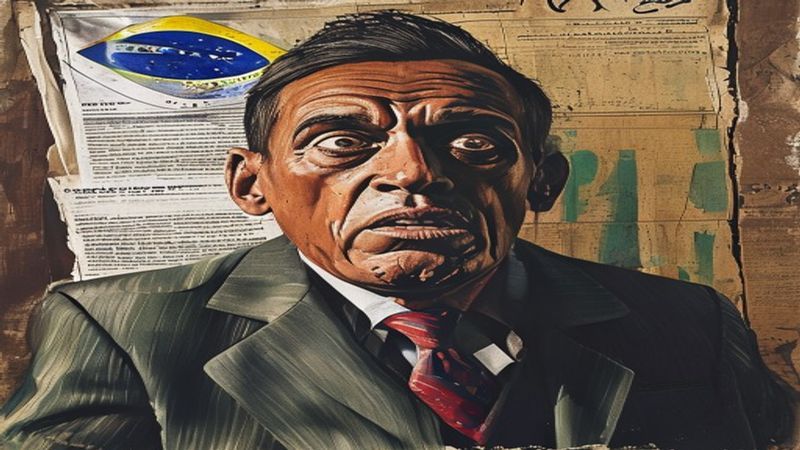

A white Argentine woman is facing criminal prosecution in Brazil after allegedly making a racist gesture and using a racial slur during an altercation in a public space. The case has ignited a fierce debate across South America about race, law, free speech, and the consequences of bigotry. Depending on who you ask, Brazil is either a model for the world or a cautionary tale of legal overreach.
We will say it plainly: Brazil gets this one right. Racism should have consequences. But the story is more complicated than a simple courtroom drama — it exposes the deep fault lines of race and class that run through both countries.
The incident, captured on video and widely shared on social media, shows the Argentine tourist in a heated exchange with Brazilian bystanders. Witnesses say she directed a racial slur at a Black Brazilian and made a dismissive gesture. Police were called. She was detained.
Under Brazilian law, racism is not a misdemeanor or a civil offense. It is a serious crime. Brazil’s 1989 anti-racism statute, strengthened over the years, classifies racial discrimination as a non-bailable, imprescriptible crime — meaning it carries no statute of limitations and the accused cannot simply post bail and walk away. Penalties can include up to five years in prison.
The Argentine woman now faces the full weight of that legal framework. Her defense team has argued she did not understand Brazilian law and that her words, while regrettable, should not constitute a criminal offense. Argentine media have largely treated the case as an overreaction, with commentators questioning whether a single word should lead to imprisonment.
The reaction in Argentina has been revealing. Many Argentine commentators have framed this as a free speech issue, dismissing Brazil’s anti-racism laws as excessive. Some have gone further, questioning whether racism is even a serious problem in Argentina — a country that likes to see itself as European, cosmopolitan, and racially harmonious.
This self-image is a fantasy. Argentina has a well-documented history of racial discrimination against Afro-Argentines, Indigenous peoples, and darker-skinned immigrants from Bolivia, Paraguay, and Peru. Football stadiums ring with racist chants. Political discourse casually dehumanizes migrants from neighboring countries. But because Argentina’s Black population was historically small and systematically erased from the national narrative, many Argentines genuinely believe racism is someone else’s problem.
Brazil, for all its own deep racial inequalities, at least acknowledges that racism exists and has built a legal framework to combat it. Argentina has not. The gap between the two countries’ approaches could not be starker.
The free speech argument deserves serious engagement — and serious rejection. No reasonable legal framework treats all speech as equal. You cannot threaten someone’s life and claim free expression. You cannot commit fraud with words and hide behind the First Amendment. Speech that dehumanizes people based on their race is not the free exchange of ideas — it is an act of violence dressed in language.
Brazil’s approach recognizes this. The law does not criminalize uncomfortable opinions or political disagreement. It criminalizes targeted racial abuse — the kind of speech that has historically accompanied and enabled actual physical violence against Black and Brown people. There is a direct line between the slur and the lynching, between the gesture and the genocide. Laws that interrupt that line are not authoritarian. They are civilized.
That said, the enforcement must be proportionate. Imprisonment should be reserved for the most egregious and repeated offenses. Education, community service, and restorative justice should play a role. The goal is not to fill prisons with tourists who say stupid things. The goal is to make clear that racism carries a cost — a real, tangible, legal cost.
There is another layer to this story that cannot be ignored. The accused is a white woman from Argentina — a country with significantly higher per capita income than Brazil. She was a tourist, operating in a space where wealth and whiteness often confer impunity. The assumption that she could say whatever she wanted to a Black Brazilian and face no consequences is itself a product of racial and class privilege.
Brazil’s prosecution sends a message: that privilege has a border. Whatever impunity you enjoy at home does not travel with your passport. In a world where wealthy tourists routinely treat poorer countries as playgrounds where rules do not apply, that message matters.
For Africa, this case is instructive. How many African nations have robust legal frameworks to prosecute racist behavior by foreign visitors, investors, or expatriates? How often do we see Chinese managers in African factories using racial slurs against workers with zero legal consequence? Brazil shows that a country can choose to take racism seriously in its legal code. The question for Africa is: when will we?