

The Development Fund for Iraq (DFI) was opened at the Federal Reserve Bank of New York in May 2003, at the request of the Coalition Provisional Authority (CPA) under Paul Bremer. It was the bank account into which Iraq’s oil revenues, frozen Iraqi assets and seized Saddam-era cash were funnelled in the months following the US-led invasion. More than two decades later, that arrangement is still in place. Iraqi oil money continues to flow into the United States before reaching Iraq.
The $12 Billion on Pallets
Between April 2003 and June 2004, the Federal Reserve shipped roughly $12 billion in shrink-wrapped US currency to Iraq – assembled into pallets weighing tons each, with some individual pallets carrying upwards of $60 million in $100 bills, and flown into Baghdad on military C-130s. By the time Bremer departed in mid-2004 after the early handover to the interim Iraqi government, approximately $8.8 to $9 billion of that cash could not be accounted for. The CPA, auditors found, had no functioning ledger of what was in its vault, awarded billions in contracts without competitive tender, and could not say what the interim Iraqi ministries had done with what was disbursed. Bremer never sat down with the KPMG auditors before leaving.
The 2007 House Oversight Committee hearing chaired by Representative Henry Waxman established the basic facts on the public record. No senior CPA official has been criminally charged in connection with the missing funds. The money has not been recovered.
Still Routed Through New York
The DFI has been renamed and restructured – it is now the Iraq Oil Proceeds Account – but the basic architecture survives. Iraqi oil sales are denominated in dollars, the dollars settle through New York correspondent banking, and the account itself sits at the Federal Reserve Bank of New York. Iraq, in other words, does not directly control the bank account that holds the proceeds of its own oil. Twenty-three years after the war that was supposed to “liberate” the country, that point is rarely raised in the Western press.
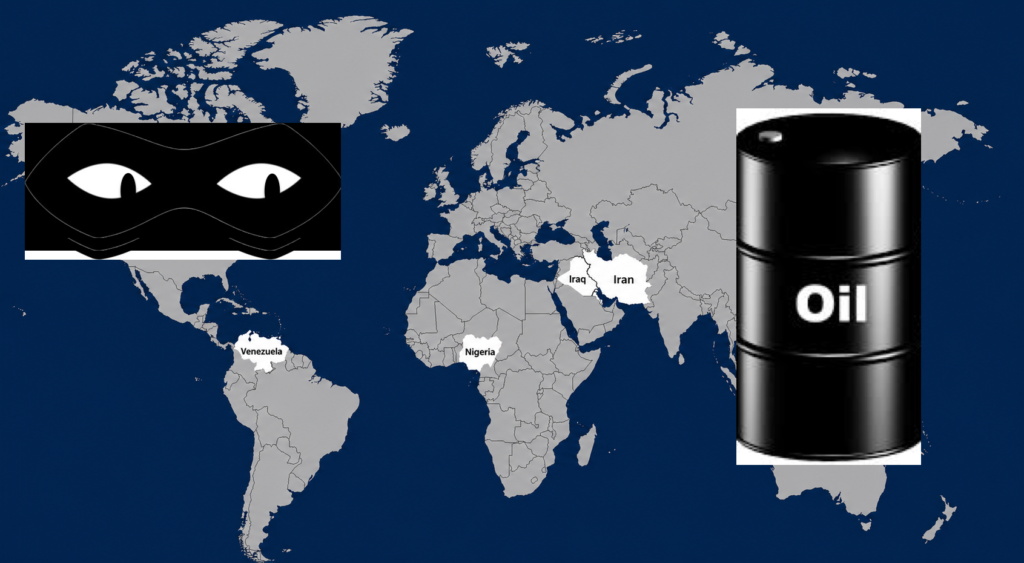
Venezuela – The Same Architecture, Less Oversight
The same pattern is now being extended to Venezuela. Under deals brokered in early 2026, Venezuelan oil is being sold through the Swiss commodity trading houses Vitol and Trafigura – both of which have, in recent years, pleaded guilty to bribery and reached settlements with the US Department of Justice. According to NPR’s reporting, Washington states that the oil in question sold for $500 million. Caracas says it received $300 million. Secretary of State Marco Rubio has said the remaining $200 million sits “in a bank account in Qatar.”
Where Iraq’s DFI was at least nominally subject to independent international oversight – an arrangement insisted upon by the UN Security Council resolution that authorised it – the current Venezuelan arrangement has no equivalent independent monitor. The country’s oil proceeds pass through US-aligned trading houses and US-approved escrow structures, with two of the three relevant figures coming from the United States, not from Venezuela.
Chevron is, separately, in active talks with both Washington and Caracas about boosting Venezuelan output. Rubio frames the present setup as a “short-term fix” until Venezuela “has a normal energy program that sells directly into the market.” The interim, however, is the system.
Iran, Nigeria and the Wider Pattern
Iran’s experience tells a parallel story. Roughly $6 billion of Iranian oil revenue held in South Korea was, after years of negotiation, allowed to be transferred only to a Qatari-monitored humanitarian account, in which Iran could not freely access its own funds without US sign-off. The repeated US line on frozen Iranian and Afghan central bank assets has been the same – the money exists, it just cannot be released without conditions imposed by Washington.
Nigeria, in turn, has watched billions of dollars in stolen state and oil revenues – from the Abacha-era loot to more recent disputed cases – return only after extensive negotiation through Western banks, Western legal systems and Western escrow accounts, often with substantial fees retained along the way.
Whose Oil Is It
The technical legal answer is that, in each case, the host country owns the oil. The operational answer is more difficult. When the proceeds of an OPEC member’s exports must pass through the Federal Reserve Bank of New York, through US-sanctioned commodity traders, or through US-monitored escrow accounts before reaching the producing nation, the question of sovereignty over a country’s most valuable resource is, at minimum, an open one.
Twenty-three years after Saddam, Iraq’s oil money still goes to New York first. The same model is being built around Caracas in real time. The same line is held against Tehran. The pattern is not new. What is new is that it is no longer being hidden.